Pelli's Design Vision

Cesar Pelli's architectural approach for the Petronas Twin Towers merged cultural symbolism with structural pragmatism. The design created not just tall buildings but specific spaces that visitors now access through ticketed entry.

The Geometric Foundation

Pelli based the towers' floor plan on Islamic geometric patterns, specifically two interlocking squares rotated to create an eight-pointed star. This configuration extended through all 88 floors, generating the towers' distinctive profile when viewed from above or in plan drawings.

The geometric system served functional purposes beyond cultural symbolism. The star pattern created natural corner conditions ideal for office layouts, maximizing perimeter exposure for interior spaces. Each floor provided more corner offices than conventional rectangular plans would allow.

This design decision indirectly shaped the observation deck experience. The non-rectangular floor plan produces varied viewing angles as visitors move around the 86th floor perimeter, with the star geometry creating alcoves and projections rather than uniform circumference.

Vertical Articulation

The towers rise in stepped setbacks that reduce their footprint as height increases. Pelli designed these setbacks to occur at specific intervals, creating visual rhythm when viewing the towers from ground level. The progression also responded to structural requirements—reducing mass at higher elevations decreased wind loads and seismic forces.

The skybridge connection at the 41st floor sits at one of these setback points. Its position reflects both structural opportunity—where both towers maintain sufficient width—and proportional aesthetics. The bridge location divides the towers' height into roughly thirds, creating balance when viewed from distance.

Pelli's office calculated that visitors accessing the towers would experience these proportions differently from ground observers. Those ascending through the Petronas Twin Towers perceive the setbacks from within, as changing floor plates and shifting geometries, rather than as external sculptural elements.

Material Expression

The towers' exterior cladding combines stainless steel and glass in proportions that balance reflectivity with transparency. Pelli selected materials that would respond to Kuala Lumpur's intense tropical sunlight without creating excessive glare or heat gain.

The stainless steel panels feature a specific finish that scatters light rather than producing mirror reflections. This treatment allows the towers to appear luminous in varied lighting conditions—the quality visible in photography of the Petronas Twin Towers from ground level.
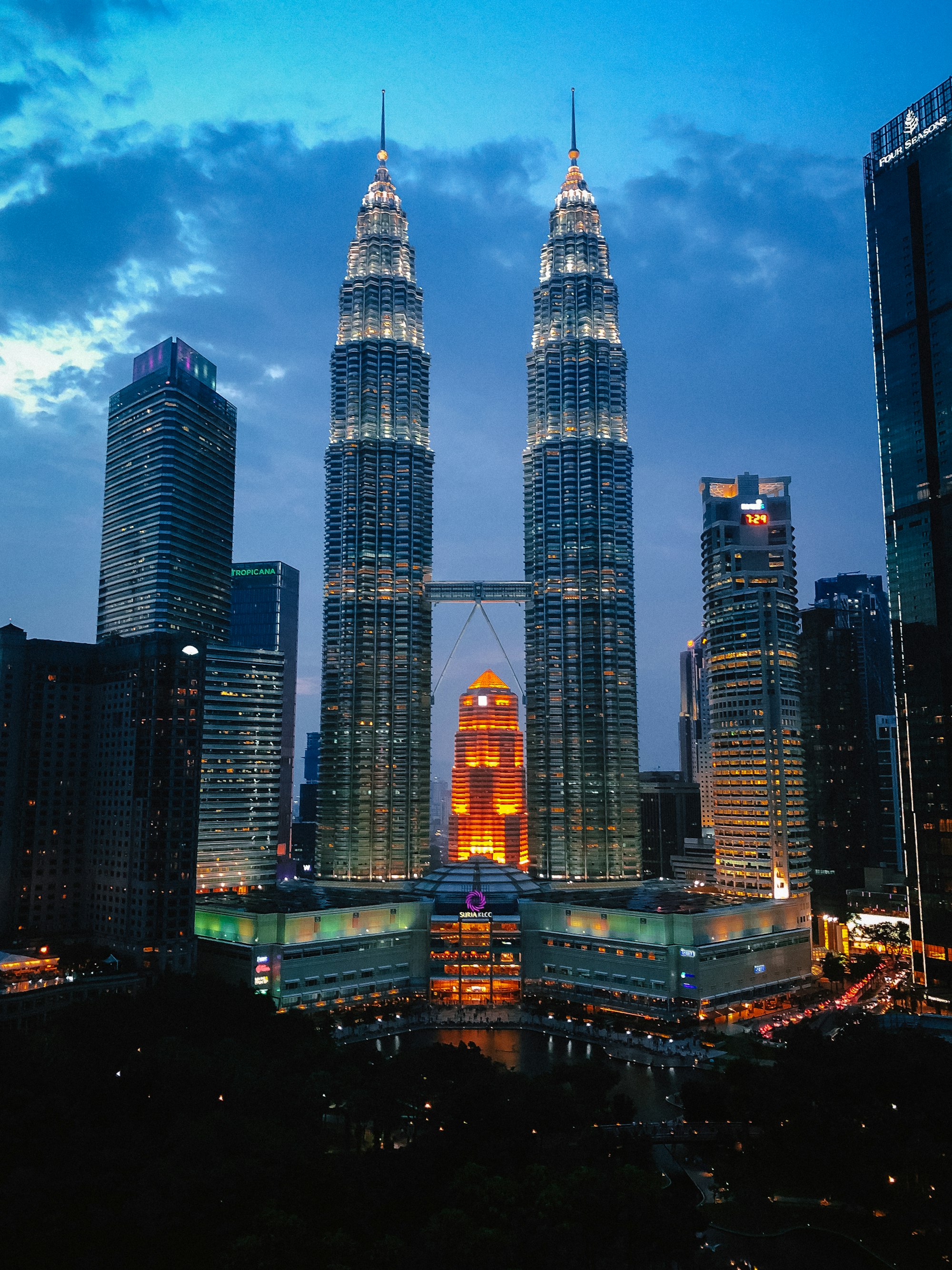
Petronas Twin Towers architecture illuminated at night showcasing Cesar Pelli's design elements and material choices
Pelli's design integrated public viewing spaces from the project's inception, rather than adding them as afterthoughts to an office building program.

Structural Systems

The towers employ high-strength concrete rather than steel for their primary structure. This decision reflected both material availability in Malaysia and structural efficiency for supertall buildings in seismic and wind-prone regions.

Concrete's mass provides inherent damping against wind-induced motion—a critical consideration for buildings exceeding 450 meters. The structural system uses a concrete core surrounded by perimeter columns, with the star geometry creating a naturally rigid configuration.

This structural approach enabled the visitor facilities that Petronas Twin Towers tickets access. The skybridge's attachment points required specific structural reinforcement at the 41st and 42nd floors, where concentrated loads transfer from the bridge into both towers.

The Pinnacle Elements

Each tower's height reaches 452 meters including the pinnacle structures. Pelli designed these spires as architectural elements rather than purely functional antenna masts. Their form echoes Islamic architectural traditions while contributing to the towers' record-breaking height when completed in 1998.

The pinnacles remain inaccessible to visitors. The observation deck at 370 meters represents the highest publicly accessible point, positioned 82 meters below the architectural pinnacle. This separation maintains structural integrity while still providing remarkable elevation for ticket holders.

Design Intent and Visitor Experience

Pelli conceived the towers as symbols of Malaysia's development aspirations during the 1990s. The design needed to project both cultural identity and technological sophistication—requirements that shaped every element from floor plan geometry to material selection.

The architect integrated public access as fundamental rather than supplementary. The observation deck and skybridge were planned from initial design phases, with structural provisions and spatial allocations built into the towers' DNA.

This integration distinguishes the Petronas experience from observation decks added to existing buildings. The visitor journey through the Petronas Twin Towers moves through spaces designed specifically for that purpose, with sightlines, circulation paths, and viewing positions considered during architectural development.

Pelli's office coordinated with elevator manufacturers to ensure the high-speed lifts could handle visitor traffic while maintaining office building efficiency. The dual-purpose requirement—serving both office workers and tourist visitors—influenced elevator placement and capacity throughout the towers.

452m
Total Height
88
Floors
1998
Completion Year

Contextual Response

The towers' design acknowledged Kuala Lumpur's tropical climate through sun shading, natural ventilation in appropriate zones, and material selections that resist weathering in high-humidity conditions. Pelli's team spent considerable effort ensuring the buildings would age gracefully in their specific environmental context.

The KLCC district development, of which the towers form the centerpiece, followed master planning principles that Pelli influenced. The surrounding park, fountains, and approach sequences all relate to the towers' design language and proportional systems.

Those who secure tickets to access the Petronas Twin Towers experience only a fraction of Pelli's comprehensive design. The observation deck and skybridge represent specific moments within a much larger architectural composition that includes office floors, mechanical systems, structural innovations, and urban planning integration.

Yet these visitor zones occupy critical positions within the design hierarchy. Pelli ensured they would provide not just functional access to height but meaningful spatial experiences—moments where architecture, engineering, and cultural expression converge at 170 and 370 meters above Kuala Lumpur.