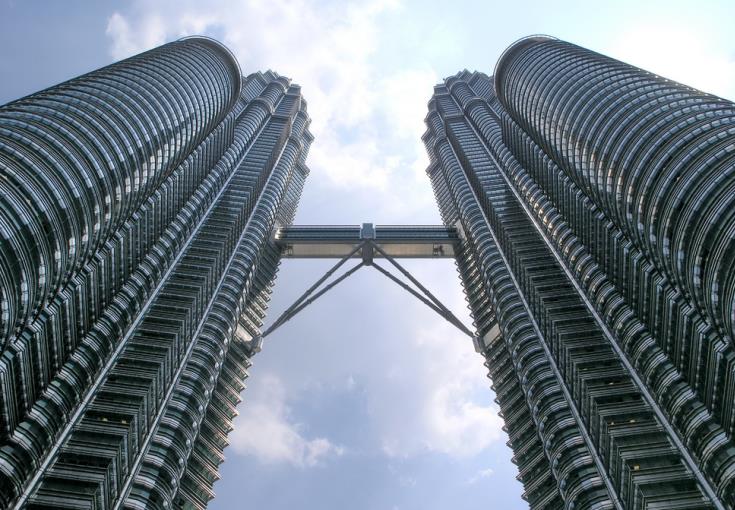
Suspended Architecture
The skybridge does not rigidly attach to both towers. Instead, it rests on sliding bearings that allow independent tower movement during wind events or seismic activity. This engineering decision transforms what appears to be a fixed connection into a kinetic element responsive to forces acting on the structures.
Visitors accessing the skybridge with Petronas Twin Towers tickets cross through a double-decker configuration. The lower level, positioned at the 41st floor, serves as the public viewing area. The upper level remains restricted, functioning as utility space and structural bracing.
The skybridge weighs 750 tons and was constructed on the ground before being lifted into position—a process that took three days to complete.
The Crossing Experience
Time on the skybridge is controlled. Groups enter in scheduled intervals, spending approximately 10 minutes within the passage. Windows on both sides provide views perpendicular to the towers' facades, revealing the urban grid of Kuala Lumpur spreading in all directions.
The sensation differs from the 86th floor observation deck experience. Here, the focus shifts from panoramic city views to the immediate presence of the towers themselves. Looking up or down through the skybridge windows reveals the towers' facades receding toward vanishing points above and below.
During the structured visit sequence, the skybridge represents a transitional moment. Visitors have ascended from ground level but not yet reached the summit observation point. The space functions as both destination and passage.
Structural Integration
The skybridge connects at the towers' 41st and 42nd floors, positioned at roughly one-third of the total height. This placement reflects structural considerations rather than arbitrary aesthetics. The towers taper slightly as they rise, and the skybridge location corresponds to a point where both structures maintain sufficient width to accommodate the connection.
Wind load calculations governed the skybridge's design. At 170 meters elevation, wind speeds and forces intensify compared to ground level. The structure incorporates aerodynamic profiling to minimize resistance, though occupants rarely perceive movement during normal conditions.